Multi-IMSI vs. eUICC: Which network switching technology is better?
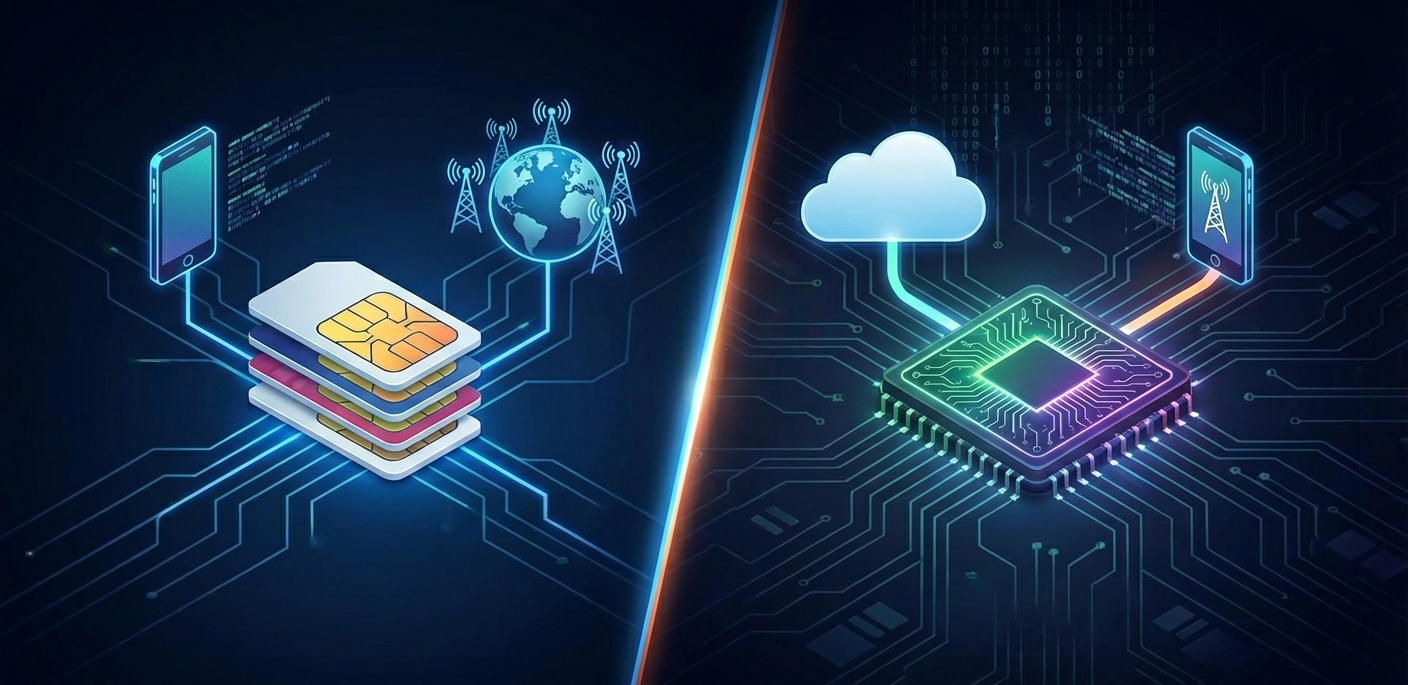
Enterprises requiring cellular network connectivity for fleet management, asset tracking, and other connected applications generally have two network switching options: multi-IMSI and eUICC. Both have a place in enterprise IoT deployments, but they operate differently and are suitable for distinct use cases.
Here’s a multi-IMSI vs eUICC comparison that will help you decide which one to use in your application.
The need for network switching
IoT devices, particularly mission-critical ones, need to be perennially connected to central databases and other devices to fulfil their functions. Asset trackers give organisations visibility over their assets. Driverless, autonomous vehicles require cellular connectivity for real-time information on traffic and road conditions plus, potentially, the movement of other vehicles.
Cellular IoT devices must continually transmit data, and IoT devices that travel, such as asset trackers, should be able to switch cellular networks. As they move from city to city and cross state lines, they must be able to seamlessly and effortlessly switch from one carrier to another.
Network switching technologies like multi-IMSI and eUICC provide IoT devices with this capability.
Multi-IMSI network switching
IMSI stands for international mobile subscriber identity, which is a 14-to-15-digit code that identifies a specific subscriber. Network operators accept or reject network registration requests based on IMSI.
A SIM typically has only one IMSI, but there are multi-IMSI SIM cards. A multi-IMSI SIM comes pre-loaded with a single SIM profile that contains multiple, exchangeable IMSIs. It also has a SIM card applet that enables automatic and autonomous IMSI (and network) switching. IMSI (and consequently network) switching may also be triggered over the air (OTA) from a central ]platform.
The muli-IMSI approach enables enterprises to provide IoT devices with international connectivity and the capability to switch networks as necessary while on a single data plan from only one operator.
Integration is very simple. Enterprises just need to install the multi-IMSI SIM card into their IoT devices. After deployment, their IoT devices will autonomously and automatically switch to the better network (e.g., lower priced, stronger signal, or wider coverage) as needed. Organisations may also trigger the IMSI change over the air.
With multi-IMSI, IoT devices can connect to multiple networks. However, enterprises get billed by and deal with only one operator.
eUICC network switching
eUICC is short for embedded universal integrated circuit card. It is the software component that enables remote SIM provisioning (RSP) on embedded SIMs (eSIMs), integrated SIMs (iSIMs), and even plug-in SIMs or removable SIMs.
eUICC is a GSMA-defined standard. It is like a virtual container that can hold and store multiple network operator profiles. Its RSP capability enables eSIM-equipped IoT devices to link to a designated eSIM IoT cloud to add, swap, activate, and delete SIM profiles over the air. Therefore, eUICC enables a device to switch profiles and connect to a better carrier as needed.
eUICC network switching under eSIM M2M
Before the eSIM IoT standard, eSIM-capable devices had to follow the eSIM M2M standard (SGP.01/.02), which enabled remote SIM provisioning but used a push model that put the operator firmly in control. The way it was configured, specifically a separate Subscription Manager - Secure Routing (SM-SR) and Subscription Manager - Data Preparation (SM-DP), meant enterprises could not very easily or readily switch operators according to their commercial interests.
Switching required integrating the replacement operator’s systems with the original operator’s SM-SR platform. Under the eSIM M2M standard, the eUICC on IoT devices was cryptographically locked to the SM-SR it had been configured with upon set-up. If an enterprise wishes to switch operators, the new operator must establish secure channels with and work with the original operator.
The new connectivity provider could create new profiles, but only the SM-SR, which remained under the original operator’s control, could push that profile to the eUICC on the enterprise’s IoT devices.
As such, eUICC network switching under the old standard required operator negotiations and cooperation, which took time and could be cumbersome.
eUICC network switching under eSIM IoT
The introduction of the eSIM IoT architecture, requirements, and technical specifications (SGP.31/.32) made the eUICC exceptionally better as a network switching solution.
The new standard unified the SM-DP and SM-SR functions into one, the SM-DP+ server and introduced two new components, the eSIM IoT Manager (eIM) and the IoT Profile Assistant (IPA).
The SM-DP+ platform simplifies provisioning, requiring no operator integration and cooperation for data preparation and secure routing to work. The eIM and IPA enable ‘push’ and ‘pull’ profile updates, respectively. Most importantly, the eIM (which is associated with an eUICC at manufacturing) can be changed, as needed, thereby eliminating vendor lock-ins.
With the GSMA eSIM IoT standard and technical specifications, subscriber profile provisioning can be device-initiated or centrally triggered from a provisioning, management and orchestration server. Indeed, the eSIM IoT standard has enabled true zero-touch provisioning and effortless network switching.
An advanced IoT device management platform makes IoT deployment even more seamless. Such a platform allows organisations to manage the entire lifecycle of their IoT devices from a single interface, from commissioning to management, provisioning, and even decommissioning.
Multi-IMSI vs. eUICC: A comparison
Both the multi-IMSI and eUICC approaches enable IoT devices to switch to a better carrier on the field as required. However, they do it differently.
Multi-IMSI swaps IMSIs, while eUICC swaps MNO profiles. Some multi-IMSI SIMs may even be capable of updating IMSI information over the air, just as eUICC SIMs can download new operator profiles over the air.
The primary difference is the operator relationship. In multi-IMSI, enterprises work with and maintain a relationship with only one provider, the original operator that provided the multi-IMSI SIM card and provides the IMSI updates (if included in the service). In contrast, eUICC allows enterprises to swap operators altogether. In other words, the eUICC SIMs can change operators on the fly, not just IMSIs.
Multi-IMSI vs. eUICC: When to use
On the one hand, the connectivity of eUICC devices may be programmed post-deployment, over-the-air. Enterprises can remotely provision their IoT devices with newer and updated operator profiles regardless of where they may be deployed. The new GSMA eSIM IoT specifications make provisioning even easier by providing flexible support, even for constrained IoT devices.
For a variety of industry uses, eUICC’s promise of universal connectivity through an unlimited choice of networks and the availability of advanced IoT device management platforms to ensure backward and forward compatibility present an attractive option. GSMA’s eSIM IoT standard and technical specifications made it even better, as they reduce the cost and complexity of deploying eUICC-equipped eSIM IoT devices.
On the other hand, multi-IMSI is a mature and field-proven network switching solution. Its autonomous switching feature is particularly convenient, as an IoT device with a multi-IMSI SIM card can switch IMSIs automatically and independently, choosing the best IMSI (and, thus, network) depending on its current location. In contrast, eUICC carrier profiles must be downloaded and activated manually (albeit remotely).
That said, the multi-IMSI solution is not as flexible as eUICC. Connectivity options can be limited by a provider’s existing network and partners.
Whether eUICC is an ideal solution depends largely on the application. eUICC is excellent for OEMs that do not have control over where their devices will end up going. With eUICC’s RSP capability, their connected devices can be provisioned wherever an operator with eSIM connectivity is present. OEMs won’t need multiple SKUs, one for each potential destination and connectivity provider.
Multi-IMSI is ideal for IoT deployments in fixed locations and where policy may restrict eUICC profile provisioning. It may also be the better option when cheaper costs and built-in resilience are a priority over flexibility. As such, for asset trackers that will ever only operate in a defined geographical area, the multi-IMSI solution is simple, is reliable, and can provide continuous connectivity for the devices’ entire lifetime.
Multi-IMSI and eUICC: A combined approach
For now, a combined multi-IMSI and eUICC approach can ensure continuous and reliable cellular connectivity for eSIM IoT devices. Specifically, this allows enterprises to take advantage of both remote service provisioning (eUICC) and autonomous switching (multi-IMSI).
How does this integrated solution work? Enterprises can deploy eSIM-enabled IoT devices and then provision them with the operator profiles of multi-IMSI carriers. eUICC will enable remote service provisioning. The profile of a multi-IMSI operator, when activated, will allow multi-IMSI autonomous network switching.
Trasna provides end-to-end SIM solutions, including a multi-tenant, multi-channel eSIM cloud management platform for IoT and a range of intelligent smart network switching solutions. To learn which is best for your business and how to improve and streamline your IoT deployment, contact a Trasna technical consultant now.

Details
The landscape of smart cities, utilities, security systems, and device manufacturing is rapidly evolving.